#ConceptualGrappling
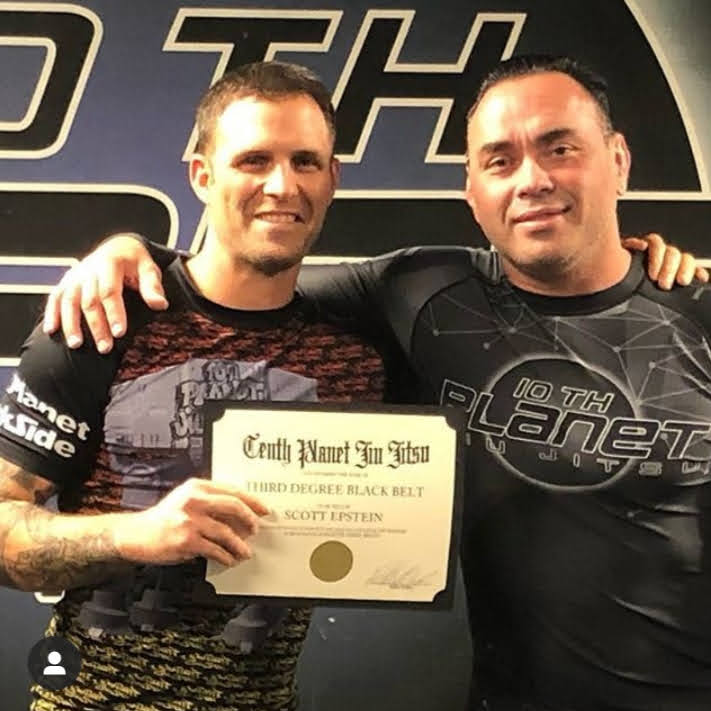
Here we Interview Scott Epstien. Along with his numerous accolades in submission grappling, Scott “Einstein” Epstein has an undefeated professional Mixed Martial Arts record (5-0), where he finished the majority his fights by submission. He was also the strength and conditioning coach of the famous UFC fighter Chuck “Iceman” Liddell and appeared on TUF season 11 as the head jujitsu coach of team Liddell.
Scott is Eddie Bravo’s first third degree black belt and currently runs 10th planet West LA. He first started jiujitsu in 1998 and has since accumulated a wealth of experience in competing, instructing, and coaching. His passion for wellness and healthy living inform his training methods and encourage his students to maximize their potential.
TABLE OF CONTENTS
- Training JiuJitsu as a Black Belt
- Strength and Conditioning For BJJ
- Transitions Between MMA and BJJ
- Questions From the Community
Training JiuJitsu as a Black Belt
Its said the jujitsu journey really begins at blackbelt. Would you say your Jujitsu style has changed over the years since receiving your black belt?
SCOTT EPSTIEN: My style has changed. I’m not in it for the kill as much anymore. Sometimes I’m specific with what I want and just go for that one thing. I’m definitely a lot more relaxed in my grappling. I just don’t care if I tap someone. I’m more about consistent transitioning and less about “let me hold you down and take what i want from you”. Now its more fun to go after what jiujitsu really is about, which is to be as sneaky as possible and setting up traps. I’m trying not to get tired and do cool setups, learn more, and figure things out that might be different and fancy.
I’m more about consistent transitioning and less about “let me hold you down and take what I want from you”
Jujitsu is central to your life, but you also have other passions like art and climbing. Do you keep them separate from jujitsu or do you think they complement each other in some respects?
SCOTT EPSTIEN: Being patient and not rushing it in art is one aspect that can be translated to jiujitsu, but its a stretch. Someone else might disagree, but I think they have limited overlap. Rock climbing on the other hand complements jujitsu very well. They both teach you how to be efficient. In jiujitsu you can see people not being efficient and then get tired and take a break. In rock climbing you need to get more technical; to get from point A to B, you cant risk overworking your muscles by just by not pacing yourself and not realying on technique. If you try to muscle your way through, then after 15 minuets your day is done and you cant move or open your hands. When I go to the rock climbing gym I want to be there for three hours. Not constantly climbing, but climbing, resting, assessing and the going back to climbing. That can transfer to jiujitsu if you let it. Its builds efficiency and of course you build up a whole lot of grip strength.
Strength and Conditioning For BJJ
You worked as the strength and conditioning coach for Chuck liddell and other UFC fighters. Can you give us a glimpse of what that training regime looked like?
SCOTT EPSTIEN: I worked with Chuck on the conditioning for his first fight. To start I’d get him on around five minuetes of leg presses. I’d use all the weight on the leg press and he would slowly go 10 second up and 10 second down until he physically couldn’t move it anymore. That would usually happen in two minutes or so, maybe a little less maybe a little more. Then after a 10 seconds rest I would tell him to slowly push as hard he could for 20 seconds. I would let him rest again for 10 seconds and then go back again for 20. After the first internval he ussually couldn’t move the weights, but that didn’t matter.
Next, I would get his heart rate way up using a static row machine, which has a wielded bar with handgrips and a weight on your chest but doesn’t move. So for 10 seconds he would pull at a 100 hundred percent of his pulling capabilities and then drop down to 20 percent for 10 seconds, and then start pulling at 100 percent again. The excerseis would last five minutes.
Then I would do something similar with a chest press with a heavy weight that he had to move in a slow and controlled fashion. Not so heavy that he couldn’t move it, but heavy enough so that after a minute or so in he couldn’t move it. Then he would go 10 seconds at a 100 percent, 20 seconds at 20 percent until he hit five minutes. Altogether, he would get three five minute rounds of a full body workout. Your basically doing a sprints without sprinting while using your whole body. No risk of injury.
Transitions Between MMA and BJJ
One of your professional MMA fights was overturned after the fight, can you talk about what happened there?

SCOTT EPSTIEN: There were three things that happened during the fight that made them overturn the decision afterwards: Firstly, during the first round I had my opponent in an arm bar and he pulled himself half-way out of the ring while I still had the submission hold on. when the referee separated us I was confused; it was my first fight and I thought I had won; I thought it was over. But instead the referee tells us we have to continue. Then the same thing happened again: I put him in an arm triangle and he started to pull himself onto the ropes and the referee stoped us and i’m like “wait, what?” Then thirdly, we both wack each other at the end of the round and both fall down. He got up first while I stayed on the ground with my arm protecting my face and scoot forward, which is when the referee stoped the fight and called it my loss. My opponent wasn’t even near me. Later, I found out the referee hadn’t called the match until more then a minute after the round was supposed to have been over! We were a minute passed, he wasn’t attacking, and I was intelligently defending myself. When the event organizer found out about all of that he overturned the decision.
What made you decide to stop fighting professionally in MMA after your fifth fight?
SCOTT EPSTIEN: For the two fights before my last fight, I felt such a joy, such a rush, after winning. I was so pumped about it, I felt amazing. But I felt different after winning my last fight. It was a televised fight on the Tapout show, so they did a documentary for the show and there was a lot of money involved. It was a cool experience but also added pressure that I wasn’t used to having, so that factored in. But I just didn’t feel good. I also didn’t like having to chase promoters to get fights and to make sure they paid what they owed me afterwards.
Questions From the Community
How can people train 10th planet if there is no 10th planet school around?
SCOTT EPSTIEN: I would take one 10th planet technique, like mission control, and practice it with your regular training partners. You have a ton of information out there on tehcniques given the high quality content people release online. And reach out to people! Unless your trying to contact Eddie Bravo, most of us will messege back. If its someone like me who puts out content, or someone else in the 10th planet system who puts out a lot of content, were likely going to respond. You can even contact good 10th planet brown belts and purple belts and they’ll hit you back up, maybe even get facetime with you. If you’re really trying to take it seriously, I’d do facetime with you! And the next step, if its really that important to you, is to save the money and take trips out here to LA. Go visit Eddie, go visit me, go out to the guys in Pasadena. Or maybe there’s a gym in the next state over and its not that expensive to get there.
If you’re really trying to take it seriously, I’d do facetime with you!
What 10th planet athlete and technique has the best chance of beating Gordon Ryan?
SCOTT EPSTIEN: The thing about Gordon Ryan is that hes a phenomenal and smart athlete thats technical and welling to adjust. And hes big. He bigger then most of our higher ranking guys. I mean we have Vinny Maghelages and Vinny already beat him. A lot of our active, younger guys are smaller. Boogie’s got a shot, but hes still not as big as Gordan so it puts him at a disadvantage.
How and when did you realize you wanted your own gym?
SCOTT EPSTIEN: I was teaching out of a gym that was technically mine when I started working with this karate gym owner that was also a student at 10th planet. But I started the business in a way most people dont, in that I never took a loss of money with the way I formatted everything. I didn’t really consider it a business, but then as I started learning more about business, marketing, and sales and I was like oh wait this is a career now. I was invited to sublease from beverly hills jiujitsu and after a few month they were like hey do you want to take over the lease, which was a lot more expenses and came with a thousand other things I didn’t want to deal with, but eventaully I did and thats when I became really serious.
Has being a gym owner after all this time lost some of its luster?
SCOTT EPSTIEN: Well right now it has, because of Corona! But no, because I enjoy having people come in and getting to know them a little bit. I used to be very stand-offish before whereas now I have these opportunities to meet a lot of cool people. Business is like another game, like jiujitu, that needs to be figured out to achieve results. The jiujitsu aspect has changed for me since I’m not as passionate about my own jiujitsu compared to when I was coming up through the ranks. Its becuase I’m very goal oriented and now I’ve achieved many of my personal jiujitsu aims. Istead, my focus has shifted to the jiujitsu of my students. I like my guys competing, pulling off cool moves in front of me, and getting better.
About the Author

Michael van Ginkel
Armed with a master’s degree in conflict archaeology and heritage, I’ve researched and excavated sites of conflict across the globe. I actively train and compete in grappling, the oldest combat sport in history

License & Copyright
The copyright holder has published this content under the following license: Creative Commons Attribution-NonCommercial-ShareAlike. This license lets others remix, tweak, and build upon this content non-commercially, as long as they credit the author and license their new creations under the identical terms. When republishing on the web a hyperlink back to the original content source URL must be included. Please note that content lin

 The Conflict Archaeologist