Leg-lock submissions in Brazilian Jiu-Jitsu have risen substantially in popularity over recent years. Practitioners in the competition circuit, including Gordon Ryan, Eddie Cummings, and Dean Lister, to name a few, have carved out a fearsome reputation through their leg-locking abilities.
“Surviving archaeological evidence and literary descriptions provides a glimpse into the leg-locking techniques of ancient fighters.”
As most grapplers by now know, leg-locks are not exclusive to jiu jitsu. From shoot wrestling, to sambo, to Judo, practitioners in many modern combat sports submit their opponents by attacking the legs. The history of leg-locks, however, stretches back farther; all the way to antiquity. Surviving archaeological evidence and literary descriptions provide a glimpse into the leg-locking techniques of ancient fighters.
The Heel-hooking Centaur
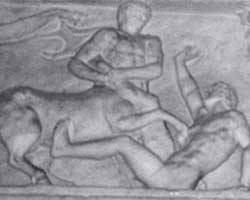
The dreaded heel hook has been a choice weapon in the arsenal of many successful modern leg-lockers, such as the members of the Danaher Death Squad. A Roman engraving currently housed in the Vatican depicts a centaur, the half horse-half-man of mythology, going for a leg-lock. The mythical subject matter makes drawing conclusions concerning position difficult, but the leg-entanglement most closely aligns with a representation of an inside heel-hook attempt from the 50/50 position.
By firmly clamping down on the toes with his armpit and securing the knee-line with a hoofed leg, the centaur leaves the victim’s heel exposed. Clasping his hands together, the centaur prepares to deal catastrophic damage to the knee. Interestingly, the artist chose to portray the centaur in top position while executing the submission, though again, the mythical nature of the depiction may have impacted the artist’s decision.
The Ankle-lock of Arrichion
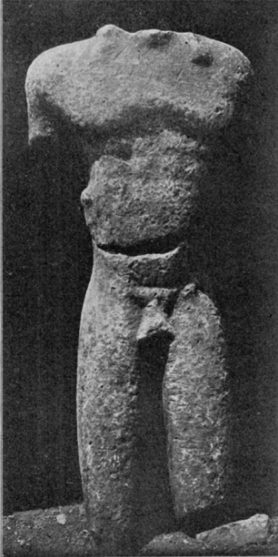
Straight ankle-locks are widely used in modern combat sports, including Judo, BJJ, Sambo, Shoot Wrestling, and MMA. Both the ancient authors Pausanias and Philotstratus describe the death of the famous fighter Arrichion, depicted right, during a pankration match, where he used a straight ankle-lock to gain a truly pyrrhic victory. While fighting off his opponents rear-naked choke, Arrichion managed to trap and dislocate his opponent’s ankle. Although Arrichion’s opponent, overwhelmed by pain, signaled his surrender, Arrichion was unable to celebrate his victory as he had already passed away.
Why Arrichion died immediately, instead of first falling into unconsciousness and therefore releasing his hold on the ankle, remains a point of contention. Philological interpretations of the ancient Greek has lead to several reconstructions of how exactly the ankle-lock was executed. What remains clear is that a well-timed ankle-lock led to Arrichion’s enduring fame.
“What remains clear is that a well-timed ankle-lock led to Arrchion’s enduring fame.”
The Heel-hook of Halter
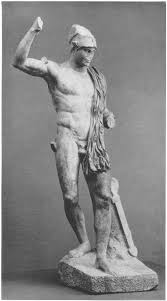
Like the absolute division of modern BJJ competitions, weight divisions did not exist in ancient pankration. The resulting differences in size between athletes forced competitors to adapt their fighting style to overcome inferiorities in strength and weight. Aware of his own diminutive stature, a Cilician athlete, baring the nickname ‘Halter,’ decided to ask the sanctuary of the Homeric hero Protesilaos, depicted to the left, how he could still overcome his rivals. According to the ancient author Philostratus, the cryptic response of “by being trampled on,” left the young athelte rather shaken.
In his following fight, however, Halter discovered the hidden meaning behind the oracle’s words; by attacking his opponent’s heels from underneath, he could mitigate their superior strength and weight. His success with leg-locks led to him becoming an undefeated pankration champion. The growing amount of leg-locks seen in MMA competitions, notably by fighters like Gary Tonen and Ryan Hall, support the notion that leg-locks can be effectively employed even under rulesets that allow for striking.
Continuing the Leg-lock Tradition
Just as in the modern era, ancient Greek athletes tended to gravitate toward an area of specialism. As speculated by Jim Aravinits, even within the narrower fields of pankration, boxing, and wrestling, athletes developed unique fighting styles. The references in ancient Greek literature to the one who wrestles with the heel (τόν προσπαλαίοντα τῇ πτέρνη) and who wrestles with the ankle (σφυρῷ προσπαλαίουσι), point to the existence of pankration fighters who specialized in leg-lock attacks.
Modern fighters in submission grappling carry on the leg-locking tradition by exploiting its deadly effect in training and competition. By building on the foundations laid by fighters over 2,500 years ago, modern leg-lockers are bringing an ancient weapon to bare.
About the Author

Michael van Ginkel
Armed with a master’s degree in conflict archaeology and heritage, I’ve researched and excavated sites of conflict across the globe. I actively train and compete in grappling, the oldest combat sport in history

License & Copyright
The copyright holder has published this content under the following license: Creative Commons Attribution-NonCommercial-ShareAlike. This license lets others remix, tweak, and build upon this content non-commercially, as long as they credit the author and license their new creations under the identical terms. When republishing on the web a hyperlink back to the original content source URL must be included. Please note that content linked from this page may have different licensing terms.

 The Conflict Archaeologist