Wrestling has existed since antiquity. Our understanding of the techniques, strategies and training of ancient wrestlers have been passed down through the writings of ancient politicians, sophists, and poets. Below you can find a repository of ancient Greek and Roman quotes on wrestling in antiquity. While the rules of wrestling differ markedly from other ancient combat sports of boxing and pankration, primary sources caution against confining our understanding of ancient wrestling to its modern derivations. Repeated mentions of submission holds, for instance, sets the combat sport apart from freestyle and Greco-Roman wrestling.
“primary sources caution against confining our understanding of ancient wrestling to its modern derivations.”
TABLE OF CONTENTS
Wrestling Philosophy
“Often what is beautiful to be done in running is ugly to be done in wrestling; and what is beautiful to do in wrestling is ugly in running” – Xenophon On the Memorable Thoughts of Socrates
“The art of living is more like wrestling than dancing, in so far as it stands ready against the accidental and the unforeseen, and is not apt to fall.” – Marcus Aurelius Meditations
“Dioxippus and Euphraeus his fellow-wrestler, both acknowledged to be the strongest men in Greece” – Hyperides In Defence of Lycophron
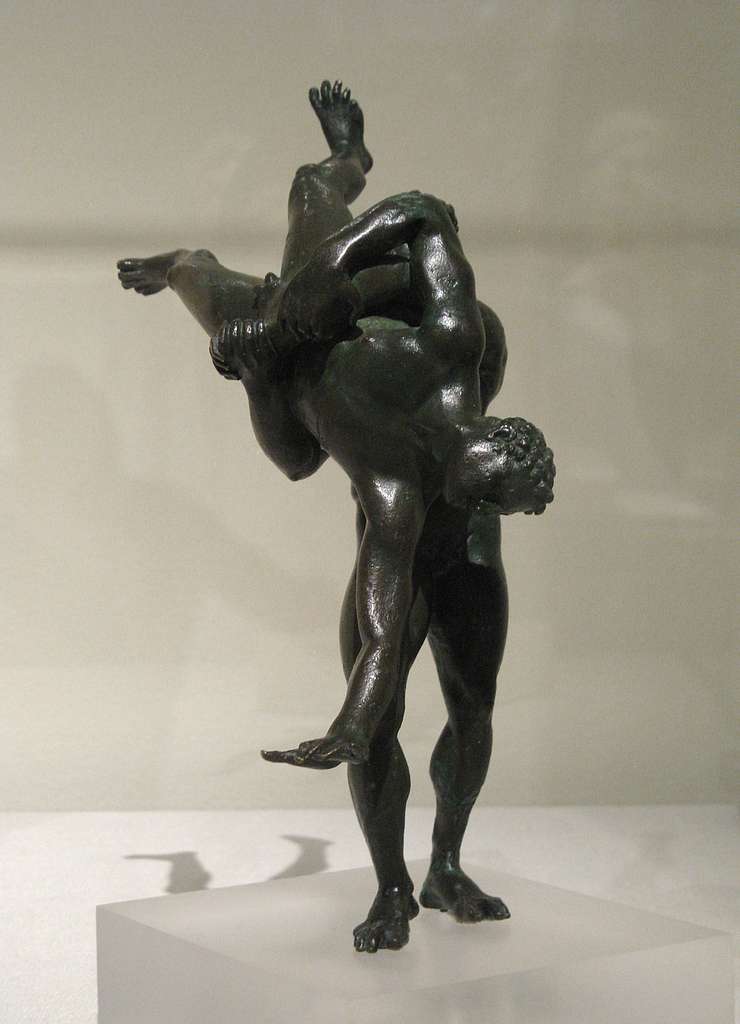
“Not if a man took lessons at a wrestling-school, and having got himself into good condition and learnt boxing he proceeded to strike his father and mother, or some other of his relations or friends, should that be a reason for hating athletic trainers and teachers of fighting in armour, and expelling them from our cities. For they imparted their skill with a view to its rightful use against enemies and wrongdoers, in self-defence, not provocation; whereas the others have perverted their strength and art to an improper use.” – Plato Gorgias
“What fortitude was yours: you have died by violence and by deed unhallowed, yourself the wrestler and yourself the thrown.” – Euripides, Hippolytus
“King Philip, who receiving a fall in a place of wrestling, when he turned himself in rising and saw the print of his body in the dust, exclaimed, Good God! what a small portion of earth has Nature assigned us, and yet we covet the whole world.” – Plutarch, De exilio
“But many, when they are accused of a crime, do not consider whether they are guilty of the matter alleged against them, but are rather solicitous whether the accuser hath nothing that may be laid to his charge; like the combatants in a match at wrestling, they take no care to wipe off the dirt that sticks upon them, but they go on to besmear one another, and in their mutual strugglings they wallow and tumble into more dirt and filthiness” – Plutarch, De capienda ex inimicis utilitate
“you do not consider that, as those that often wrestle are wrestlers at last, so you by often exciting laughter will become ridiculous yourself.” – Plutarch, Apophthegmata Laconica
“Difficulties are the things that show what men are. Hence-forth, when some difficulty befalls you, remember that god, like a wrestling-master, has matched you with a rough young man. For what end? That you may become an Olympic victor and that cannot be done without sweat.” Epictetus in Discourses
Wrestling Techniques
“And what about the wrestling? The pankratiasts, my boy, practice a dangerous brand of wrestling. They have to endure black eyes which are not safe for the wrestler and learn holds by which one who has fallen can still win, and they must be skillful in various ways of strangulation. They bend ankles and twist arms and throw punches and jump on their opponents. All such practices are permitted in the pankration.” – Philostratus The Imagines
“Unhappy Phaedimus, and Tantalus, so named from his maternal grandsire, now
had finished coursing on the track, and smooth. Shining with oil, were wrestling in the field; and while those brothers struggled—breast to breast— another arrow, hurtling from the sky, pierced them together, just as they were clinched. The mingled sound that issued from two throats was like a single groan. Convulsed with pain, the wrestlers fell together on the ground, where, stricken with a double agony, rolling their eyeballs, they sobbed out their lives.” – Ovid Metamorphoses
“That country was then ruled by Antaeus, son of Poseidon, who used to kill strangers by forcing them to wrestle. Being forced to wrestle with him, Hercules hugged him, lifted him aloft, broke and killed him; for when he touched earth so it was that he waxed stronger, wherefore some said that he was a son of Earth.” – Apollodorus, Library
“But Menoetes, son of Ceuthonymus, who tended the king, challenged Hercules to wrestle, and, being seized round the middle, had his ribs broken.” – Apollodorus, Library
“For one who is able to throw his legs about in a certain way, to move them rapidly and with long strides, makes a good runner; one who can hug and grapple, a good wrestler.” – Aristotle, Rhetoric
“This is the great fault in wine; it first lays hold of the feet; ’tis a cunning wrestler.” – Plautus, Pseudolus
“Alcibiades, while still a boy, was caught in a fast hold in a wrestling-school, and, not being able to get away, he bit the arm of the boy who had him down. The other boy said, ‘You bite like a woman.’ ‘No indeed,’ said Alcibiades, ‘but like a lion.” – Plutarch, Regum et imperatorum apophthegmata
“And having thrown the man completely spread out in the dust Aiakos got on the middle of his opponent’s back and sending his outstretched feet along under the spread out stomach, binding together a bent bond around just above the knees, he pressed sole on sole and encircled the ankles to their outermost tips; And having quickly stretched himself over his opponent’s back, and winding his hands over each other like a wreath, he cast a bond on the neck with his arm, having bent his fingers; He drenched the heaped up sand with soaking wet sweat, cleaning off the running drops with dry sand, so that the entwined man might not slip through the knot of his hands. While sending hot moisture down from his squeezed neck. And while he was being squeezed by the sharp palm. The heralds chosen as overseers of the games wandered over, so that the forearm with the yoked-together lifting-strap would not kill him. For there was not at that time such a rule, which their descendants made later on, that when a man is overwhelmed by the strangled pain of necks being stretched by bonds he gives over the victory to his wrestling opponent with sensible silence, having tapped the winning man with a shameful hand.” – Nonnos, Dionysiaca
‘But whenever someone is impudently folding himself around (the opponent) and
not yet conceding that he has fallen down, he is the same as the idiots of the wrestlers
who, having been made to fall down by the wrestling experts and are lying with their
backs on the ground, are so far from noticing the fall that they keep control of the necks of the ones having thrown them, not allowing them to escape, and because of this they assume that they win.” – Galen On the Natural Faculties
“which one of them is raw, or baked in the sun or not, so you might get to know one who is inactive and open, pulling him down after throwing him over from the Chersonese after hooking his leg with yours behind his knee then after you turn his shoulder over, you fall heavily upon him.” – Aristophanes The Knights
“but the matters of correct wrestling: the freeing-up of necks and hands and sides,
exercising with eager rivalry and under established rules with beautiful bodily strength
for the sake of health, these things being useful for all things are not to be neglected.” – Plato Laws
“Then balancing him on high he suddenly unexpectedly sent him back down and landed him on his side, and following the prostrate man encircled his neck with his right hand, and his groin with his feet. Being choked, he is discouraged and he resists only out of shame. After a while his chest is stretched out on the ground and he on his prone stomach, and after a long time he gets up dejected, leaving the disgraceful prints on the ground as witnesses.’” – Statius Thebaid
“And suddenly, having run up, he dashed his forearm into Theagenes’ neck just
like a prying-bar and while the thump from the blow was being hear far away.” – Heliodorus Ethiopian Tale
“And having hooked him under his armpit he gripped around him tightly at the back, and with difficulty he girded his stomach and fastened his hands together, and having pried the bottom of his foot at the heel along the ankles and the ankle bones violently and continuously, and having forced him to bend down onto his knees, he encircled him with his feet and with the parts below his groin, having attacked his legs, and lifting up the wrists which the Ethiopian was leaning heavily upon while struggling to keep his chest away (from the ground), and leading his forearms around the man’s temples in a noose and stretching them up towards the man’s middleback and shoulders he forced his stomach down to spread out over the earth.” – Heliodorus Ethiopian Tale
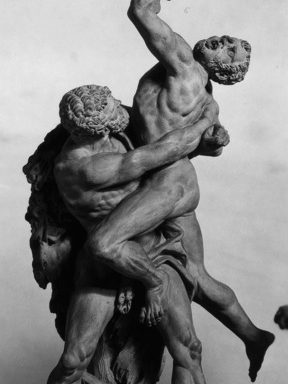
“For such shoulders, even while the neck is being bent and wrenched by the
wrestling, are good guards, pressing against the head from the arms.” – Philostratus On Gymnastics
“Then, having fallen upon him, he does not allow the man to lift up his head, pressing the man’s head into the mud. And to finish him off now, having twined his legs around him along the man’s belly, having laid his forearm under the man’s throat, he strangles the poor guy, and the poor guy pats his strangler’s shoulder, begging, I suppose, that he not strangle him to death.” – Lucian. Anacharsis
Wrestling Ruleset
“These folk standing up, who also have been coated with dust, punch and kick at each other in their attacks. And now this poor wretch looks like he is going to spit out even his teeth, his mouth is so full of blood and sand, having just taken a blow on the jaw.” – Lucian Anacharsis
“To this day among some of the barbarians, especially in Asia, when prizes for boxing and wrestling are offered, belts are worn by the combatants. And there are many other points in which a likeness might be shown between the life of the Hellenic world of old and the barbarian of to-day.” – Thucydides The Peloponessian War
“Thus it happened that two soldiers, one of whom belonged to the 5th legion, while the other was one of the Gallic auxiliaries, challenged each other in sport to a wrestling match. The legionary was thrown, and the Gaul taunted him.” – Tacitus, The History
“The Argives made use of flutes at their wrestling matches called Stheneia; which sort of sport was first instituted in honor of Danaus, but afterwards consecrated to Jupiter Sthenius, or Jupiter the Mighty.” – Plutarch, De musica
“But if he fell on his shoulder in a fight, he wiped it, then denied that he had fallen, and went on wrestling.” – Aristophanes The Knights
“For Cimon also was a good man, as were Ephialtes and Thucydides, but when the last named was asked by Archidamus King of the Spartans whether he or Pericles was the better wrestler, he replied, ‘Nobody can tell; for whenever I throw him in wrestling, he says he was not thrown and wins by persuading the onlookers.” – Plutarch, Praecepta gerendae reipublicae
“But just as the people who are complete idiots when it comes to wrestling moves,
sometimes, not realizing that their back is lying on the ground, keep holding the throat of the people who threw them down, and do not allow them to stand up, in the same way also these people being untutored in the falls of words do not allow them to be released.” – Galen. On the Natural Faculties
“For in these things, the one having thrown someone down and stretched him out
on his back or his face on the ground … carries off the first prize for himself.” – Philostratus On husbandry
“grabbing us by the waist and throwing us outside of the wrestling-ground, is the
very same thing, even if not a fall, but it is equally a defeat.” – Nilus PG
‘”And so in the contest of this age there are some who wrestle in a certain way
without fear and according to law and they compete only with bindings and of the body,
they do not learn to hit, they who are called wrestlers.” – Ambrose Commentary on Psalm
“Nor is the prize gotten, if he has not been laid prostrate on his belly or distended
with a bond of the biceps.” – Ambrose Commentary on Psalm
“This is only one of the three wrestling falls.” – Aeschylus Eumenides
Wrestling Strategy
“There is a vast difference here between the taught and the untaught, the trained and the untrained warrior. For just as the athlete who is thoroughly practiced in the pancratium or in boxing or wrestling is capable of fighting on his left side, and does not move that side as if it were numb.” – Plato Laws
“The statue of Milo the son of Diotimus was made by Dameas, also a native of Crotona. Milo won six victories for wrestling at Olympia, one of them among the boys; at Pytho he won six among the men and one among the boys. He came to Olympia to wrestle for the seventh time, but did not succeed in mastering Timasitheus, a fellow-citizen who was also a young man, and who refused, moreover, to come to close quarters with him.” – Pausanias, Description of Greece
“The trainers of the wrestling school do not impart the various throws to their pupils that those who have learnt them may make use of all of them in actual wrestling matches, for weight and strength and wind count for more than these, but that they may have a store from which to draw one or two of such tricks, as occasion may offer.” – Quintilian, Institutio Oratoria
“For stratagems array unexpected difficulties against men who try to defend themselves against them, if they suspect and await them; but he who does not await nor even suspect any stratagem gives no hold to the opponent who is trying to outwit him, just as, in a wrestling bout, he who does not stir gives no advantage to his antagonist.” – Plutarch, Agesilaus
“And when they were exhausted, just like in athletics they stood apart from each
other for a short recovery of breath and then entwined themselves together again.” – Appian The Civil Wars
Wrestling Training
“The practices I allude to are those to which, while enjoying robust health, we submit: such, for instance, as rubbing the body with wax and oil, a preparation for a wrestling match, by rights, but which, these men pretend, was invented as a preservative of health.” – Pliny the Elder, The Natural History
“It is further stated that Milo carried his own statue into the Altis. His feats with the pomegranate and the quoit are also remembered by tradition. He would grasp a pomegranate so firmly that nobody could wrest it from him by force, and yet he did not damage it by pressure. He would stand upon a greased quoit, and make fools of those who charged him and tried to push him from the quoit.” – Pausanias, Description of Greece
“He used to perform also the following exhibition feats: He would tie a cord round his forehead as though it were a ribbon or a crown. Holding his breath and filling with blood the veins on his head, he would break the cord by the strength of these veins. “It is said that he would let down by his side his right arm from the shoulder to the elbow, and stretch out straight the arm below the elbow, turning the thumb upwards, while the other fingers lay in a row. In this position, then, the little finger was lowest, but nobody could bend it back by pressure. – Pausanias, Description of Greece

“They say that he was killed by wild beasts. The story has it that he came across in the land of Crotona a tree-trunk that was drying up; wedges were inserted to keep the trunk apart. Milo in his pride thrust his hands into the trunk, the wedges slipped, and Milo was held fast by the trunk until the wolves—a beast that roves in vast packs in the land of Crotona—made him their prey.” – Pausanias, Description of Greece
“They relate that at a banquet of the philosophers, when one of the pillars in the hall gave way, Milo sustained the ceiling while they all escaped, and afterwards saved himself. It is likely that, trusting to the same strength, he met his fate as related by some, for whilst making his way through a thick wood, he strayed considerably out of the path, when finding a great log with wedges in it, he thrust both his hands and feet into the fissure, intending to split it completely, but was only able to force it enough to let the wedges fall out, when the gaping log presently closed on him, and he, being taken as in a snare, was devoured by wild beasts.” – Plautus, Pseudolus
“The ones pressing together below are wrestling, and they learn to fall down
safely and to stand back up easily, and pushings, entwinings, bendings, to endure to be
choked, and to lift the other wrestler up high.” – Lucian. Anacharsis
Wrestling Society
“The city cultivated martial discipline and athletic exercises to a great extent, and in one of the Olympic games all the seven wrestlers, who obtained the palm in the stadium, were Crotoniatæ; whence, it seems, the saying arose that the last wrestler of Crotona was the first of the other Greeks, and hence they say also is the origin of the expression, ‘more salubrious than Crotona,’ as instancing a place which had something to show, in the number of wrestlers which it produced, as a proof of its salubrity and the robust frame of body which it was capable of rearing.” – Plautus, Pseudolus
“Its celebrity too was not a little spread by the number of Pythagoreans who resided there, and Milo, who was the most renowned of wrestlers, and lived in terms of intimacy with Pythagoras, who abode long in this city.” – Plautus, Pseudolus
“And since it was the custom in Crete for women to view the games, Ariadne was present, and was smitten with the appearance of Theseus, as well as filled with admiration for his athletic prowess, when he conquered all his opponents. Minos also was delighted with him, especially because he conquered Taurus in wrestling and disgraced him, and therefore gave back the youths to Theseus, besides remitting its tribute to the city.” – Plutarch, Theseus‘
“He was beautiful to look at, and his deeds did not belie his beauty when by his victory in wrestling he had Aegina with her long oars proclaimed as his fatherland.” – Pindar Olympian
“Cato, on the contrary, though he had for his antagonists almost all the greatest and ablest men in Rome, and though he kept on wrestling with them up to his old age, never lost his footing.” – Plutarch, Comparison of Aristides with Marcus Cato
“But just as those athletes who win crowns in wrestling and the pancratium on a single day are called, by custom, ‘Victors-extraordinary,’ so Cimon, who in a single day crowned Greece with the trophies of a land and sea victory, may justly have a certain pre-eminence among generals.” – Plutarch, Comparison of Lucullus and Cimon
“Philip, who was sojourning in the place and had an hour of leisure, came to see the young men and boys of Cardia exercising in the pancratium and in wrestling, among whom Eumenes had such success and gave such proofs of intelligence and bravery that he pleased Philip and was taken into his following.” – Plutarch, Eumenes
About the Author

Michael van Ginkel
Armed with a master’s degree in conflict archaeology and heritage, I’ve researched and excavated sites of conflict across the globe. I actively train and compete in grappling, the oldest combat sport in history
Related Content

License & Copyright
The copyright holder has published this content under the following license: Creative Commons Attribution-NonCommercial-ShareAlike. This license lets others remix, tweak, and build upon this content non-commercially, as long as they credit the author and license their new creations under the identical terms. When republishing on the web a hyperlink back to the original content source URL must be included. Please note that content linked from this page may have different licensing terms.

 The Conflict Archaeologist